


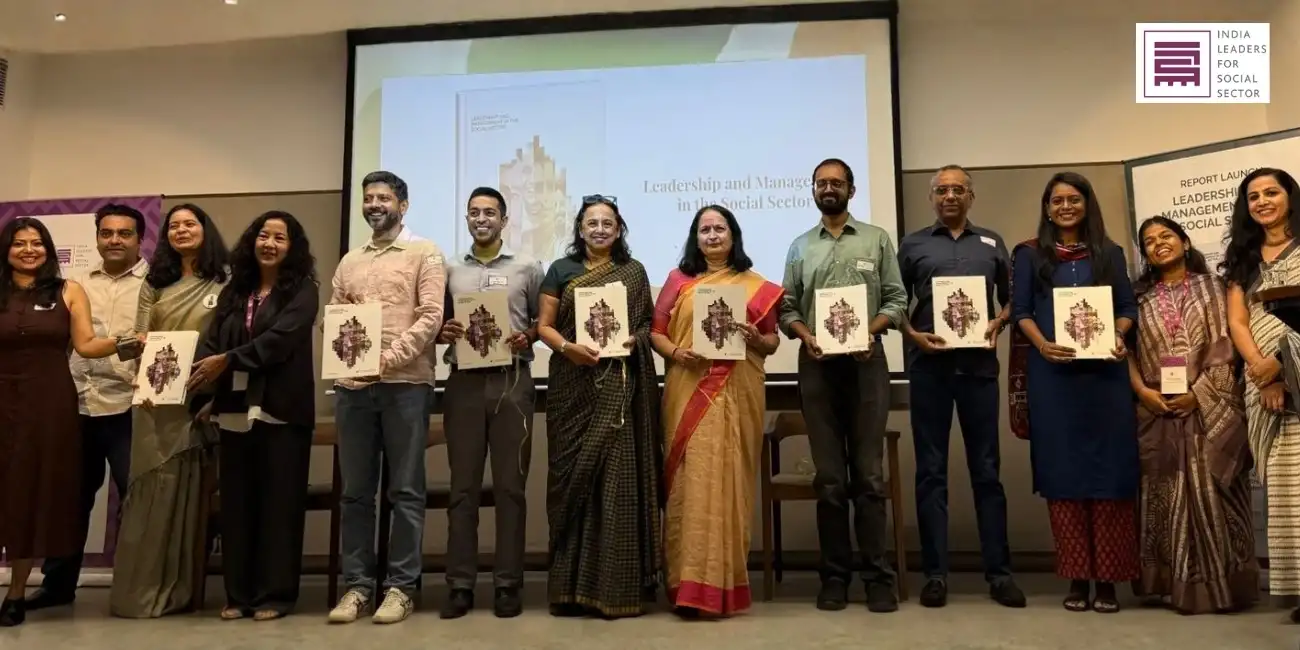
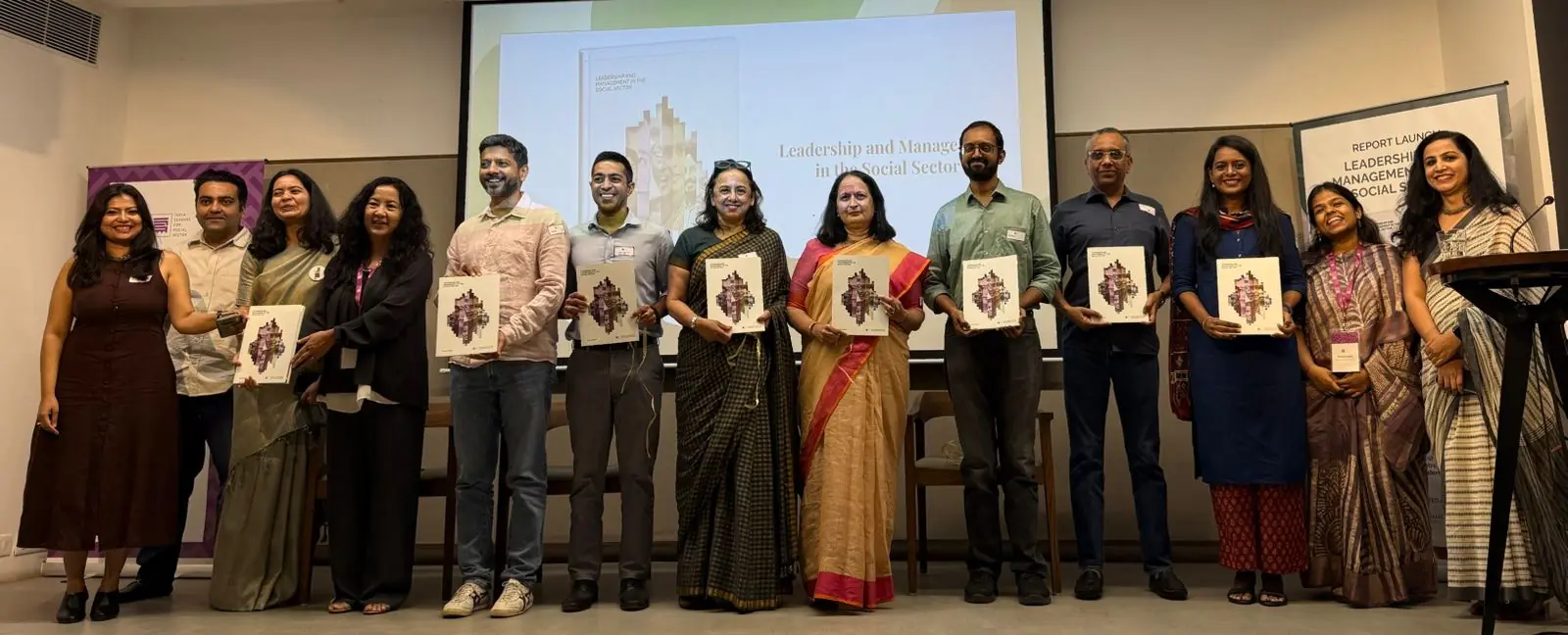
India’s social sector has never had a shortage of vision. What it lacks, in most cases, is the management infrastructure to carry that purpose forward without leaning entirely on one person: the systems, the people practices, the career pathways and succession planning that let an organisation grow past the energy of its founders. That was the thread running through an evening we hosted in Bengaluru, around the launch of our report, Leadership and Management in the Social Sector, built on conversations with over 40 nonprofit founders, CEOs, funders, sector experts, and government stakeholders. At the launch, Mekin Maheshwari of Udhyam Learning Foundation spoke, followed by a panel with Krishnan S. of Janaagraha, Utsav Kheria of Rocket Learning, and Subhashree Dutta of the^delta, and finally Shankar Maruwada of EkStep. Each of them, coming from very different places, landed on some version of the same point we had already arrived at while building the research instrument. An organisation that depends on its founder/s for every decision isn’t really an institution. Not yet, anyway.
Passion built the organisation. It won’t sustain it.
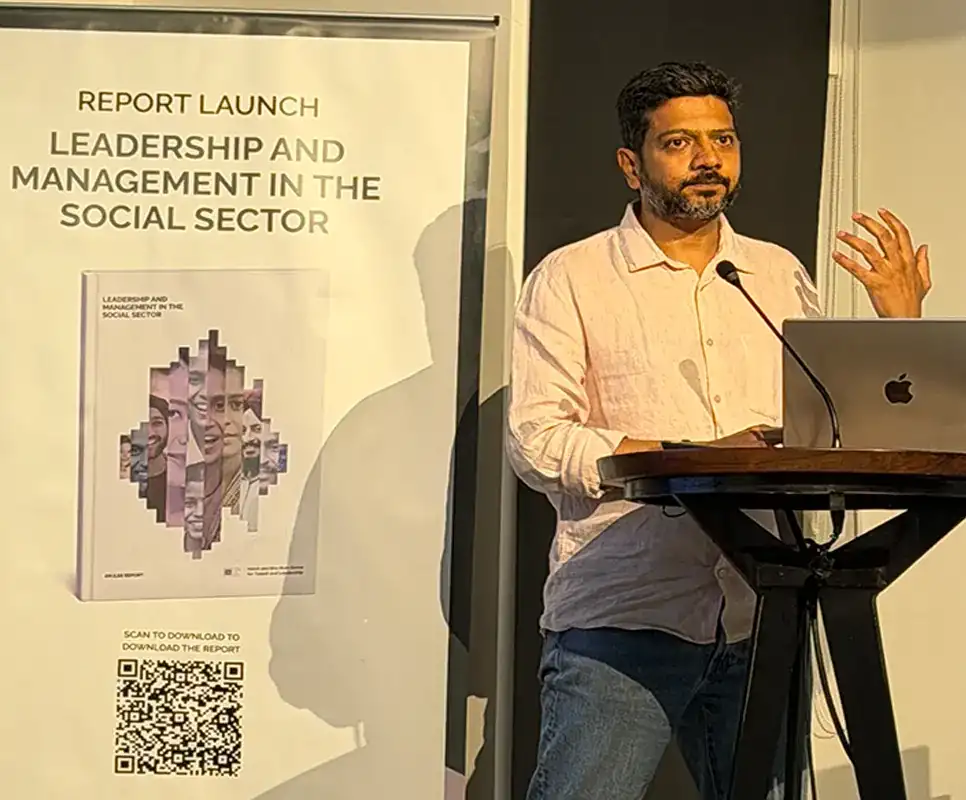
Ask most nonprofit founders what got their organisation off the ground and the answer is rarely a system. It’s conviction, a refusal to look away from a problem long enough to build something around it. But as Mekin Maheshwari put it, reflecting on a decade leading Udhyam, the instincts that build an organisation aren’t the same ones that let it scale. He spoke about what he calls the Gandhari principle, a blindfold worn with the best of intentions: he refused to use his own corporate network to help Udhyam grow, wanting the organisation to earn every inch on its own merit, and because he funded its early years himself, no one was ever forced to build real fundraising muscle in those years.
The one area he invested in deliberately from day one was people and culture. At Udhyam, every hiring, promotion, and performance conversation is guided by the same three-lens framework: mindsets, competencies, and personal standards.
All three – Mindsets, competencies, and personal standards – together, every time. Not two out of three. Not the one that’s most convenient in the moment.
— Mekin Maheshwari, Founder & CEO, Udhyam Learning Foundation
This gap kept resurfacing across our research: organisations talk about mission alignment endlessly, but only a few build the systems to hire, promote, and retain people consistently against it. Anu Prasad, our Founder and CEO, named it directly in her introduction to the report, reflecting on seven years of working alongside the sector’s leaders. ‘We have seen their tenacity and grit, but we have also seen the quiet, heavy toll of ‘doing it all.’’
We often ask leaders to scale their missions without giving them the scaffolding to scale their leadership.
Strategy has to live somewhere other than a document
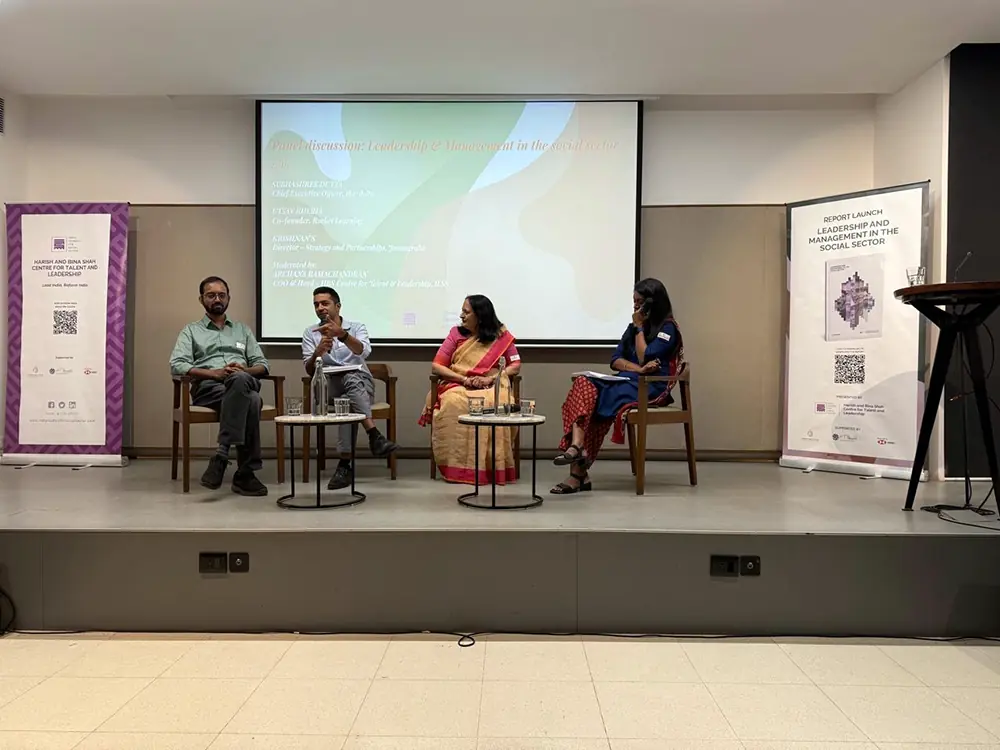
The panel with Krishnan S., Utsav Kheria, and Subhashree Dutta kept circling back to where strategy actually lives once the offsite is over. Krishnan described how Janaagraha translates strategy from a document into everyday practice. It starts with a shared vocabulary that everyone understands, extends to the operational autonomy people need to make decisions confidently, and is reinforced through quarterly reflections where leaders collectively review and shape the organisation’s direction.
Utsav, from Rocket Learning, made a related point from the funding side: the organisation, which now has a reach of close to five million children, has said no to funders more than once when a partnership didn’t fit the mission, a discipline that only holds if it’s practised before it’s tested, once a leader truly accepts that they are not permanent.
People join for the mission. But they stay for the culture, which is shaped by the systems that translate vision into the lived reality of people’s lives.
— Krishnan S., Director – Strategy and Partnerships, Janaagraha
Subhashree, who works with social entrepreneurs through the^delta, named a pattern she sees in the founders who actually pull this off: clarity about what they’re solving for without being attached to how, fundraising capability that’s built rather than borrowed from the founder’s own contacts, and the hardest one, a willingness to hire people who are simply better than them.
Some founders feel intimidated and end up hiring someone just a little inferior to them. Those who cut through that, either by bringing in stronger talent or growing it internally, are the ones who build organisations that scale.
— Subhashree Dutta, CEO, the^delta
Our research names this gap with precision. It isn’t a talent problem so much as a systems one: there aren’t enough deliberate pathways and incentives for anyone other than the founder to hold real decision-making weight. Half the nonprofits we surveyed told us they don’t have the internal leadership capacity their organisation needs, which tracks with what Bridgespan found looking at Indian nonprofits: the gap widens past roughly fifty employees, the point where the founding team can no longer hold every thread personally, and more than half weren’t confident anyone could run things if the senior-most leader stepped away.
What holds an organisation together when the founder isn’t in the room
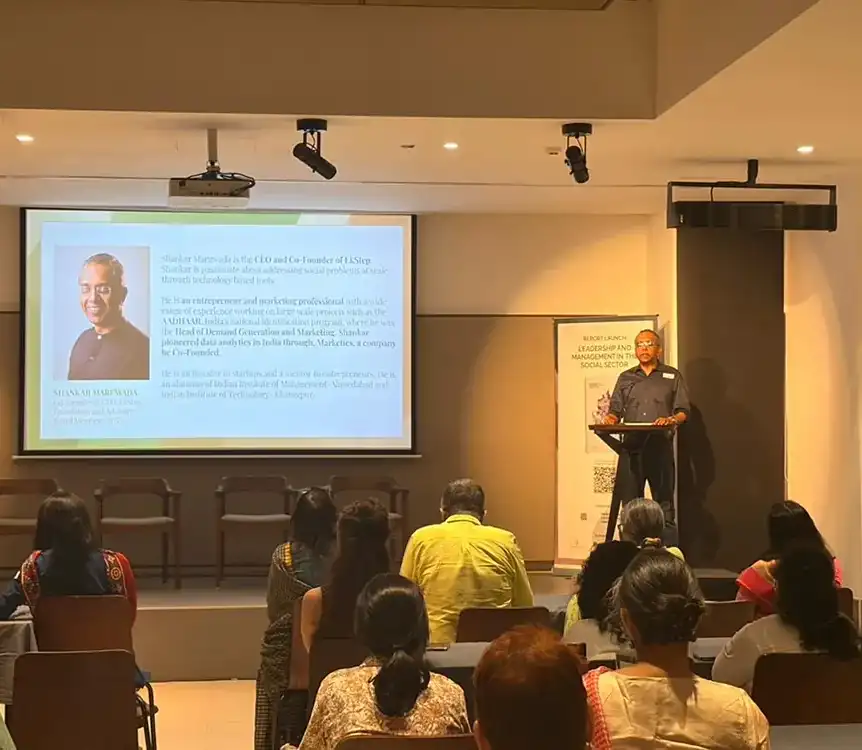
Shankar Maruwada, Co-founder and CEO of EkStep, closed the evening with the sharpest reframing of the night. Nonprofit leadership today, he argued, isn’t about restoring stability but about building the capacity to navigate instability that isn’t going away. As he put it, the next normal will not be a return to equilibrium; it will be turbulence as the baseline.
The sector tends to celebrate a particular kind of leader, visibly solving and loudly inspiring, exactly the model that stops an organisation from building anything that could outlast its founder. Great leadership looks boring, in his telling: quiet, anticipatory, reading signals early, preventing problems before they turn into crises, spending its energy developing people who can lead without waiting for direction from the top.
His most useful idea was a different definition of institution itself. Rather than seeing it as a building or a registered entity, he described it as a set of clear boundaries that enable rather than restrict. By defining what is possible, and what is not, those boundaries give people the confidence to make decisions without looking to the founder for every judgment call.
You cannot have an organisation where it is unclear what you cannot do
— Shankar Maruwada, Co-founder and CEO, EkStep
That’s the whole distinction. A founder who absorbs every decision builds dependence; an institution that holds its boundaries clearly enough for others to decide within them builds something that lasts. It’s why our program runs on a bench of academicians and practitioners alongside a structured peer cohort, rather than one charismatic faculty member presiding over everything.
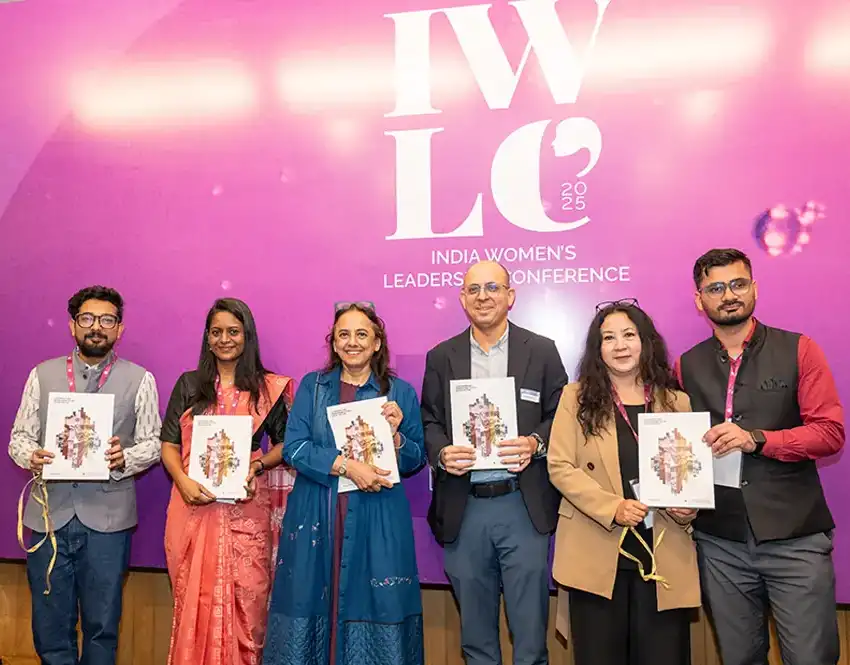
Bikkrama Daulet Singh, Operating Partner at The Convergence Foundation, made a similar point at the report’s soft launch at the India Women’s Leadership Conference, drawing on twelve years of watching organisations like Central Square Foundation up close. He spoke about the discipline of building an n-1: four or five leaders capable of independently leading major parts of the organisation.
That, he argued, was what enabled the Central Square Foundation to truly scale. It was also the thread connecting mission, talent, governance, and capital, allowing the organisation to outlast any one individual at the top.
When leaders pair mission clarity with management discipline, organisations become steadier, teams grow, and impact multiplies.
— Bikkrama Daulet Singh, Operating Partner at The Convergence Foundation
The sector already knows this. The harder part is building for it.
None of this surprised anyone in the room who has spent real time in India’s social sector, and that is partly why our research took the shape it did. We made a deliberate choice not to ask people what leadership training they wanted, but where things actually broke down, and let the gaps tell us what the curriculum needed to be. That question became the ILSS Advanced Nonprofit Leadership and Management Program. It is built directly on what this research surfaced, module by module, because we did not want to build another leadership course that sounds good in a brochure and falls apart on a Tuesday afternoon when the systems aren’t there to hold things together.
Anu’s framing resists the easy version of this argument, the one that just tells founders to delegate more. Her point is structural, not personal. ‘While founders continue to provide vision and direction, long-term strength depends on the wider leadership bench,’ she wrote in the report’s foreword, ‘those who can translate vision into strategy, manage people and resources effectively, and foster a culture rooted in purpose.’ The sector has never really been short on motivation. What it doesn’t have enough of is infrastructure, and that is not something a single workshop can hand anyone. It has to be built by listening carefully to where leaders are actually stuck, then designing backward from that: a long series of decisions about who gets hired, who gets trusted with judgment calls, and what an organisation is willing to build before it is forced to. That is the work we are most interested in right now, and it is the work this program exists to support.
About the Author
Archana’s work experiences have focused on leading projects and teams in Learning and Leadership across the Corporate, Government and Social sectors. Prior to ILSS, she worked as the City Director at Teach for India (TFI) where she led the strategy and operations for the TFI Fellowship and Alumni Movement to create a movement for educational equity. Prior to Teach for India, Archana worked with Infosys Leadership Institute and Boston Public Schools in the areas of Human Capital, Competency Development, Change Management and Diversity and Inclusion.
Archana is an Alumna of the Master’s Program in Education (M.Ed.) at Harvard Graduate School of Education at Massachusetts, Master’s Program in Management (MBA) at T.A. Pai Management Institute, Manipal and the Bachelor’s Program in Commerce (B.COM) at Stella Maris College, Chennai. Across all roles and teams, being a learner and an educator is the core of her work.

Jasmine Saha is a dynamic professional with five years of experience in data analytics and the social sector. She began her career as a senior business analyst, specialisng in automation and process building. Driven by a passion for impact, she joined Teach For India, where she worked on grassroots education reform and piloted a STEM learning project in schools. Jasmine thrives in cross-functional, fast-paced environments and is deeply interested in education and social innovation. Originally from Kolkata, she enjoys exploring new places, cuisines, and cultures.

Prerna is currently a program manager at ILSS, working within the Harish and Bina Shah Centre for Talent and Leadership.
Her professional journey has spanned advertising, the arts, and higher education. She began her career as a digital copywriter before moving to the St+art India Foundation, and later spent three years with the academics team at the Vedica Scholars Programme for Women, supporting curriculum design, classroom learning, and student mentorship. Working closely with students and faculty shaped her enduring interest in how learning unfolds in practice.
Comments are closed